

Product, honestly
AI forex trading bot: what the AI actually does, and how to test one
 Tommy J.Founder, RoboticEA
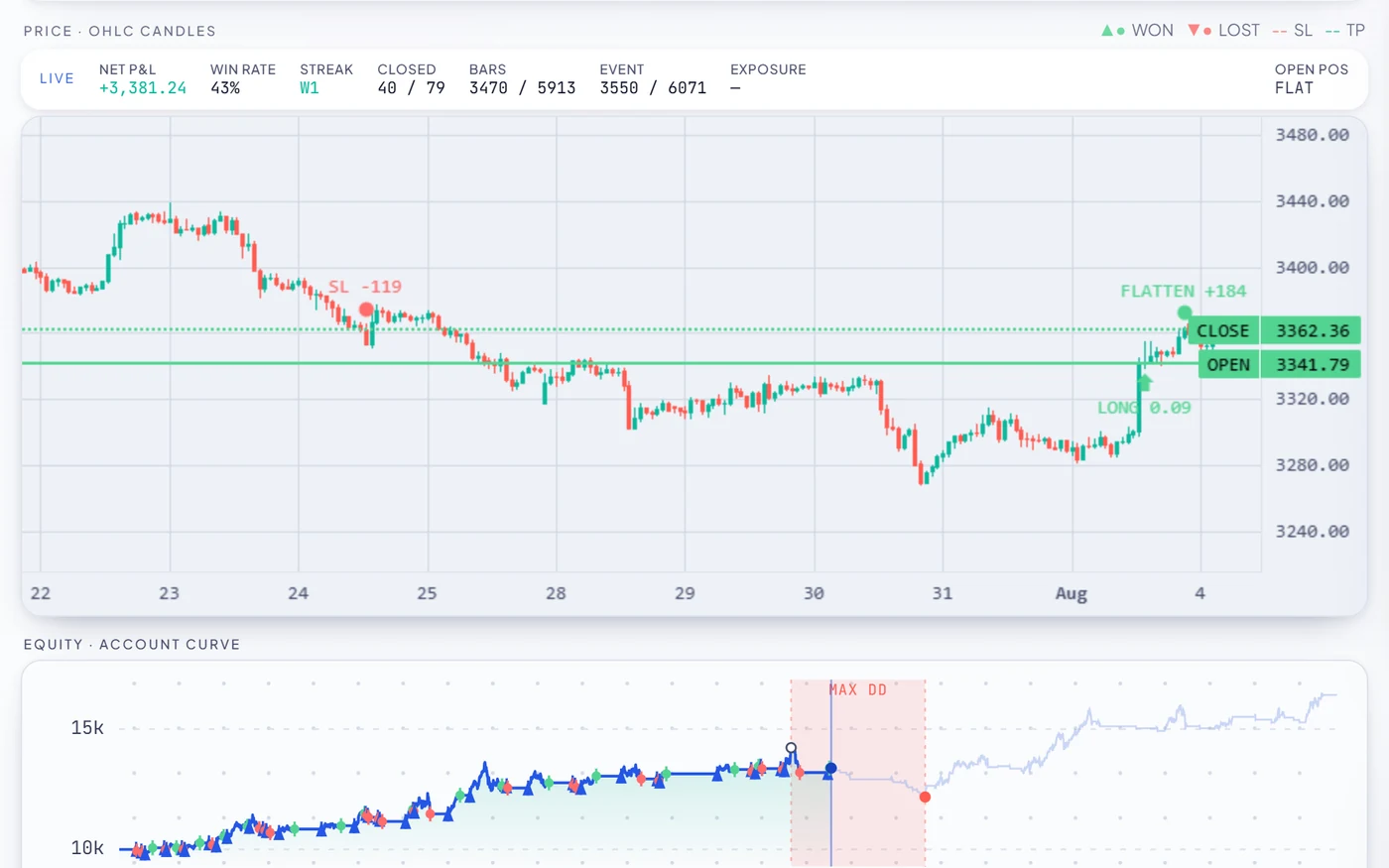
An AI forex trading bot is usually sold as a machine that has learned the market. Ours does something much smaller, and we think more useful: you describe the kind of strategy you want in plain English, a language model turns that sentence into the settings of a strategy generator, and a deterministic C++ engine backtests every strategy it produces on real market bars with the spread charged. The AI never sees a price and never forecasts one. This page explains exactly where it sits, what our own data says about bots that claim more, and how to test any bot — ours included — before it goes near an account.
The short answer
Definitions
What an AI forex trading bot actually is
A forex trading bot — an expert advisor in MetaTrader’s vocabulary — is a set of rules a platform executes for you: enter when these conditions line up, exit at this stop or that target, size the position like so. Every automated trading bot is that, whatever the marketing says. The rules may have been written by a person, found by a search, or fitted by a machine-learning model, but by the time the bot is running on an account it is a fixed recipe reacting to prices.
“AI” can mean three quite different things in this market, and it is worth knowing which one you are being offered:
- AI as a forecaster. A model trained on past prices that claims to predict the next move. This is what most adverts imply. It is also the hardest version to verify, because a model fitted to history will always describe that history well.
- AI as a search tool. Software that generates and tests many rule sets and keeps the ones that scored best. Useful, and dangerous in a specific way we measure below: the best score in a big search is partly luck.
- AI as an interface. A language model that turns what you say into something a machine can run. This is the only kind of AI in RoboticEA, and it is the least magical of the three by design.
None of these categories is a scam in itself. But only the last one makes no claim about the future, which is why it is the only one we were willing to build.
Precisely
What the AI does inside RoboticEA, step by step
On the Compose screen you choose a strategy family (or several), set the generator’s dials, and press one button: the generator invents a batch of fresh strategies and the engine backtests every one of them. The dials can be set by hand or, on a paid plan, by switching to AI mode and typing what you want.
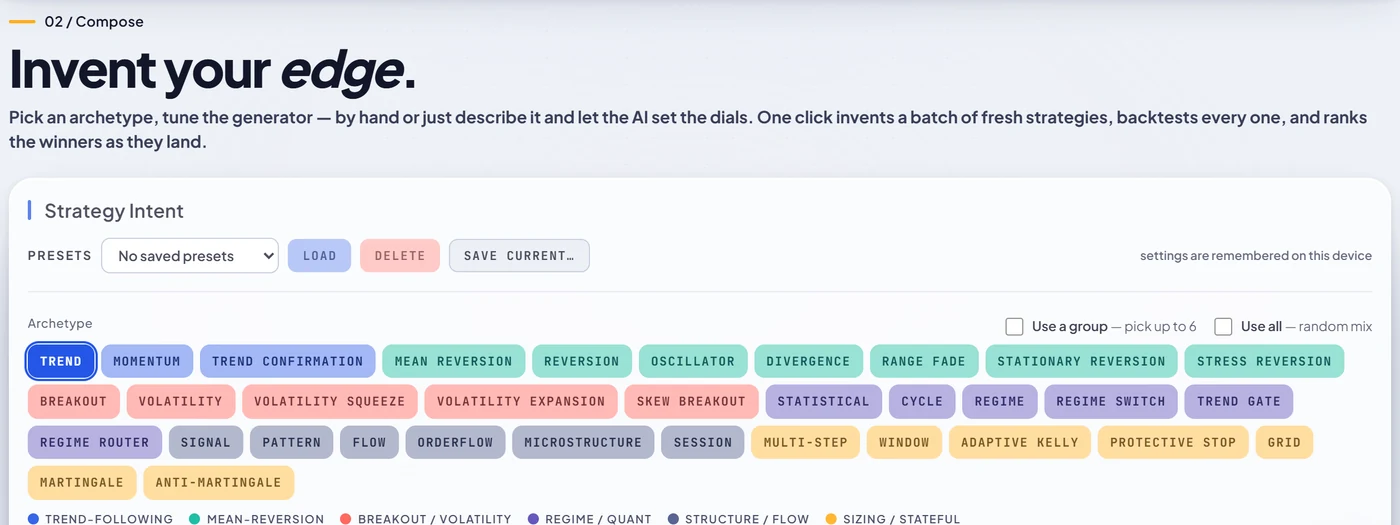
Here is what happens when you type a sentence such as “patient trend-following on the hourly chart, low risk, let winners run” and press Tune with AI:
- The model is told it does not write strategies. Its instructions open with exactly that sentence. It is given your current settings and asked for one small JSON object — which archetypes, which ranges — plus a one-line explanation that appears beside the button as “AI set: …”.
- It edits rather than resets. Anything your sentence does not mention is left exactly as you had it. If you had deliberately lowered your risk band and then asked for “more breakout ideas”, your risk band stays where you put it.
- Its answer is clamped by code. Every number is forced back inside fixed bounds and any archetype name that is not on the list is dropped. The model cannot set risk above 10% per trade or invent a strategy family, however it phrases its reply.
- The sliders move, and you can still move them. The AI’s values animate onto the same dials you would set by hand. Nothing is hidden behind the prompt.
- Then the AI is finished. The generator that builds the strategies is parametric and deterministic and makes no model calls. The backtests run on our own engine. The per-year validation is the engine again.
| Setting the AI may change | Allowed range | What it controls |
|---|---|---|
| Archetypes | 1–6 of 34, or all | which strategy families the batch is drawn from |
| Lookback | 2 – 300 | indicator periods, in bars — fast or slow |
| Reward : risk | 0.5R – 10R | distance of the profit target relative to the stop |
| Stop × ATR | 0.5× – 10× | stop distance, scaled to recent volatility |
| Risk per trade | 0.1% – 10.0% | share of the account at risk on each trade |
| Confirmations | 1 – 4 | how many conditions an entry needs |
| Exit styles | rr, trailing, breakeven, time, signal | target, trailing, break-even, time or signal exits |
| Batch size | 5 – 100 | how many strategies to generate (capped by plan) |
If no model is available, a keyword fallback reads the same sentence and moves the same dials, less cleverly — and it, too, starts from your current settings rather than resetting them. The app labels that answer “heuristic” so you can tell which one you got. Either way the output is a starting point for a search, not a prediction.
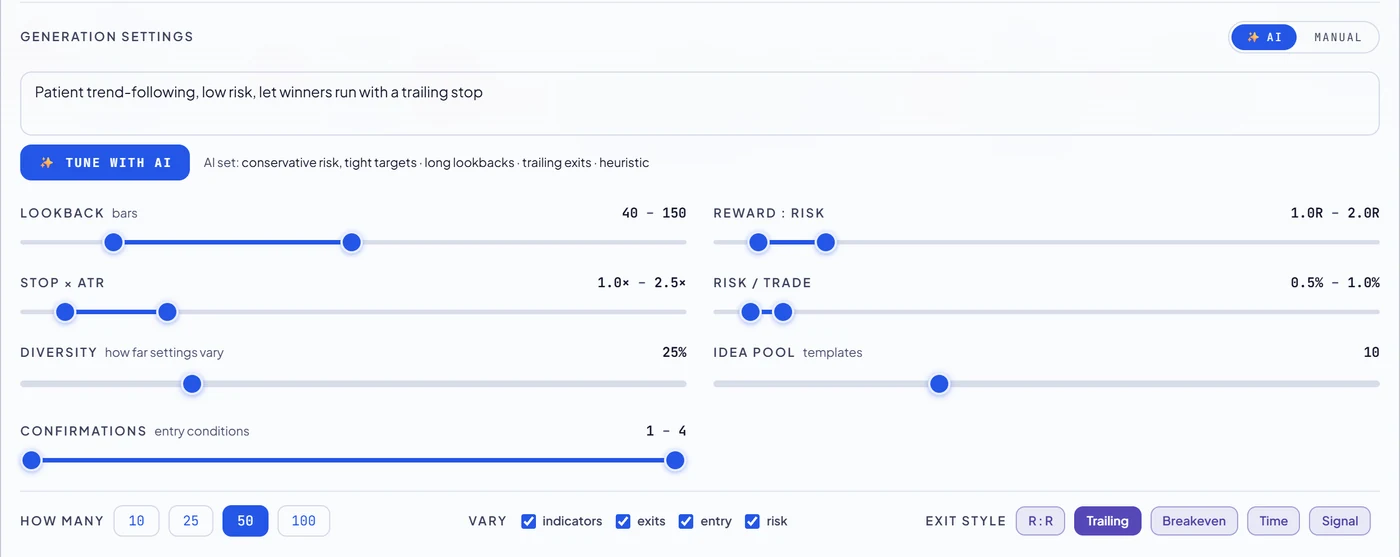
What that one sentence produced
We then pressed Generate with those dials: 25 fresh trend strategies on XAUUSD, split across H1 and H4, each backtested on 2025 with the recorded spread charged. This is the top of the batch, ranked by return as the results landed:
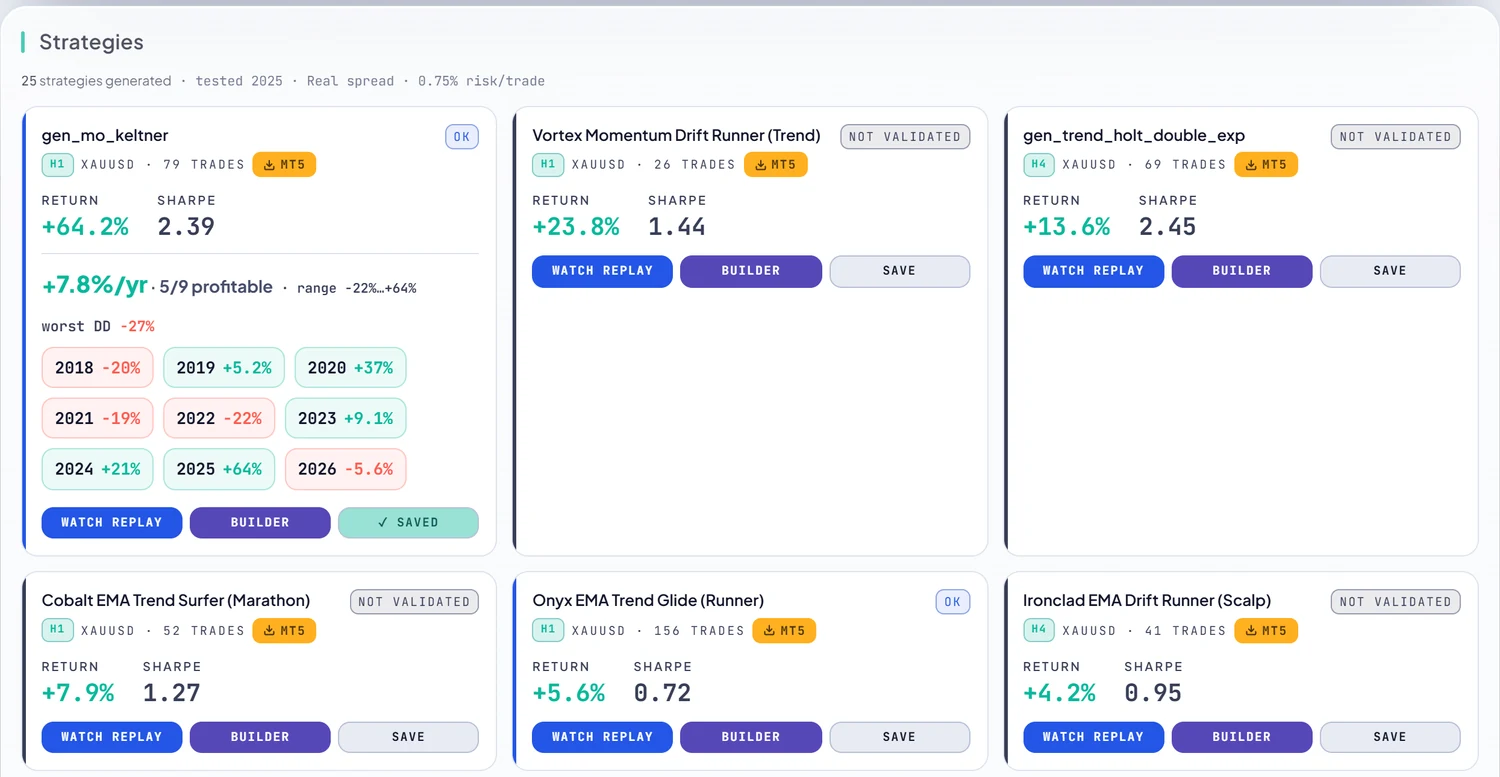
That is the honest shape of an AI-assisted search. The sentence aimed the generator well — every strategy in the batch is a patient, low-risk trend follower, as asked — but it did not make any of them good. The best result of the year is exactly the kind of number a bot advert would lead with, and the per-year record beside it is exactly what the advert would leave out.
Boundaries
What the AI cannot do
Stating the limits plainly matters more on this topic than almost any other, so here they are:
- It does not see market data. The model receives your sentence and your current settings. No prices, no charts, no news.
- It does not predict anything. It is never asked where a price is going, and nothing it returns is a forecast.
- It does not trade. RoboticEA does not connect to your broker. Strategies leave as a MetaTrader 5 expert advisor you download, read and run yourself.
- It does not make a strategy profitable. A well-phrased request produces a well-targeted batch. Whether anything in that batch survives is decided by the backtests, and most of the time, as our studies show, nothing does.
- It is not on the free plan. AI tuning is available on paid plans only. A free account — 250 tokens once, no card — uses the manual sliders, which set exactly the same things.
The evidence
Why the AI does not predict prices: what happens out of sample
Every price-forecasting bot shares one problem: it was fitted, selected or tuned on the same history it is advertised with. We cannot test anyone else’s model, but we can test the mechanism, because ranking strategies by past return is the simplest version of “learning from history”. We did it twice, in a 48,640-run study.
Move the strategies to other instruments
Take the top 25 strategies by in-sample return — all scale-free, with stops based on ATR and position size as a percentage of the account, so nothing ties them to one instrument’s units — and run each one on 12 instruments.
| Timeframe | On its home instrument | On instruments it was not chosen on | Rank correlation ρ |
|---|---|---|---|
| H4 | +5.34% | -4.09% | 0.059 |
| H1 | +15.25% | -18.27% | 0.210 |
| D1 | +1.97% | -0.96% | -0.041 |
+15.25% → -18.27%
the same top-ranked H1 strategies, at home and transplanted
Nothing about the strategies changed — only the instrument. 95% interval for the transplanted figure: -19.21% to -14.27%.
Move the years instead
A second design: 200 strategies on two instruments, the top 10 picked on some years, then scored on years they were never selected on — averaged over 4 splits.
| Cell | Top 10, in sample | In-sample max DD | Same 10, unseen years |
|---|---|---|---|
| H4 GBPUSD | +4.31% | -9.16% | -6.43% |
| H4 EURUSD | +11.20% | -15.95% | +1.43% |
| H1 GBPUSD | +8.40% | -31.65% | -20.16% |
| H1 EURUSD | +40.70% | -37.46% | -26.26% |
The strongest in-sample cell, H1 EURUSD, went from +40.70% to -26.26%. That is the whole case against a bot whose only evidence is its own history: the better a selection looks in sample, the more of that look is likely to be fit. A model with millions of parameters can fit history far more closely than a ranking can, which makes the problem larger, not smaller. And one warning from the same study, about how easily this fools the person running it: One split of four pointed the opposite way to the other three and would have been reported as a finding on its own.
That is why the AI in RoboticEA sits at the front of the pipeline and not at the decision point. It helps you choose what to search. What the search finds still has to survive years and instruments it was not picked on, and you are shown when it does not.
Describe it, then test it properly
Generate a batch, backtest every strategy on real bars with real spread, and see every year separately — losing years included. Free account, no card; MetaTrader 5 export included.
Friction
The cost assumption behind most automated trading bots
The second reason a bot’s advertised curve and a live account disagree is cheaper to explain: the spread. We backtested 4,129 gold strategies on each of 8 full years separately, then re-ran the identical cells with trading costs switched off. Nothing else changed.
14.1%
of yearly runs profitable, real recorded spread
38.1%
of the same runs profitable, zero cost
24.0%
of runs profitable only because costs were off
65 → 0
strategies profitable in all 8 years, costs off vs costs on
With no spread, 65 strategies show a flawless 8-year record — the raw material of a sales page. Charge the spread actually recorded on XAUUSD and there are 0. Same strategies, same years, same engine.
One more figure from the same study, because it is exactly what a bot leaderboard shows you. The strategy with the highest average yearly return — a Cycle strategy on M5 — averaged +367.6% a year. Run its years back to back and the account compounded to -100.0%: one spectacular year cannot pay for the years that empty the account. A bot advertised on its average, or on its best year, can be the one that blows up. The full gold breakdown is in the gold EA study.
The market
Why most AI forex bots sold online cannot show a verifiable record
Put the two findings together and the typical “AI forex robot” listing makes sense. It is rarely fraud in the strict sense. It is a strategy selected on the history it is shown with, tested with a cost model that is not stated, and delivered in a form you cannot inspect. Each of those is an ordinary shortcut; together they make the record impossible to check:
- The rules are hidden. A compiled file can be run, not read. If you cannot see what the bot does, you cannot tell whether the “AI” is a model, a moving average or a grid that doubles down on losers.
- The test is one curve. A single compounded line hides which years made the money. Our 700,000-backtest study shows how much the choice of window alone moves a result.
- The spread is not stated. Above, switching costs off turned 24.0% of runs from a loss into a profit.
- The selection is not disclosed. If the bot is the best of a thousand candidates, its backtest is the top of a distribution, and the transplant table above is what the top of a distribution tends to do next.
- “AI” cannot be falsified. The word describes how something was built, not how it performs. It adds no evidence, and it is often used in place of evidence.
Practical
How to test a forex trading bot yourself
You can apply these questions to any forex bot, from any source, before risking money on it. They are ordered so the cheapest eliminations come first.
- Can I read the rules? Readable source or a precise specification. Without it, every other answer is the seller’s word.
- What spread and commission were charged, in numbers? If nobody can say, the backtest is not evidence.
- Show me every year separately, losing years included. Then ask for the worst one by name.
- What was the maximum drawdown, beside the return? A return quoted alone is half a number.
- How many trades a year? A handful of trades is not a record, however smooth the line.
- Was it tested on data it was not chosen on? Other years, other instruments. This is the question that separates a measurement from a memory.
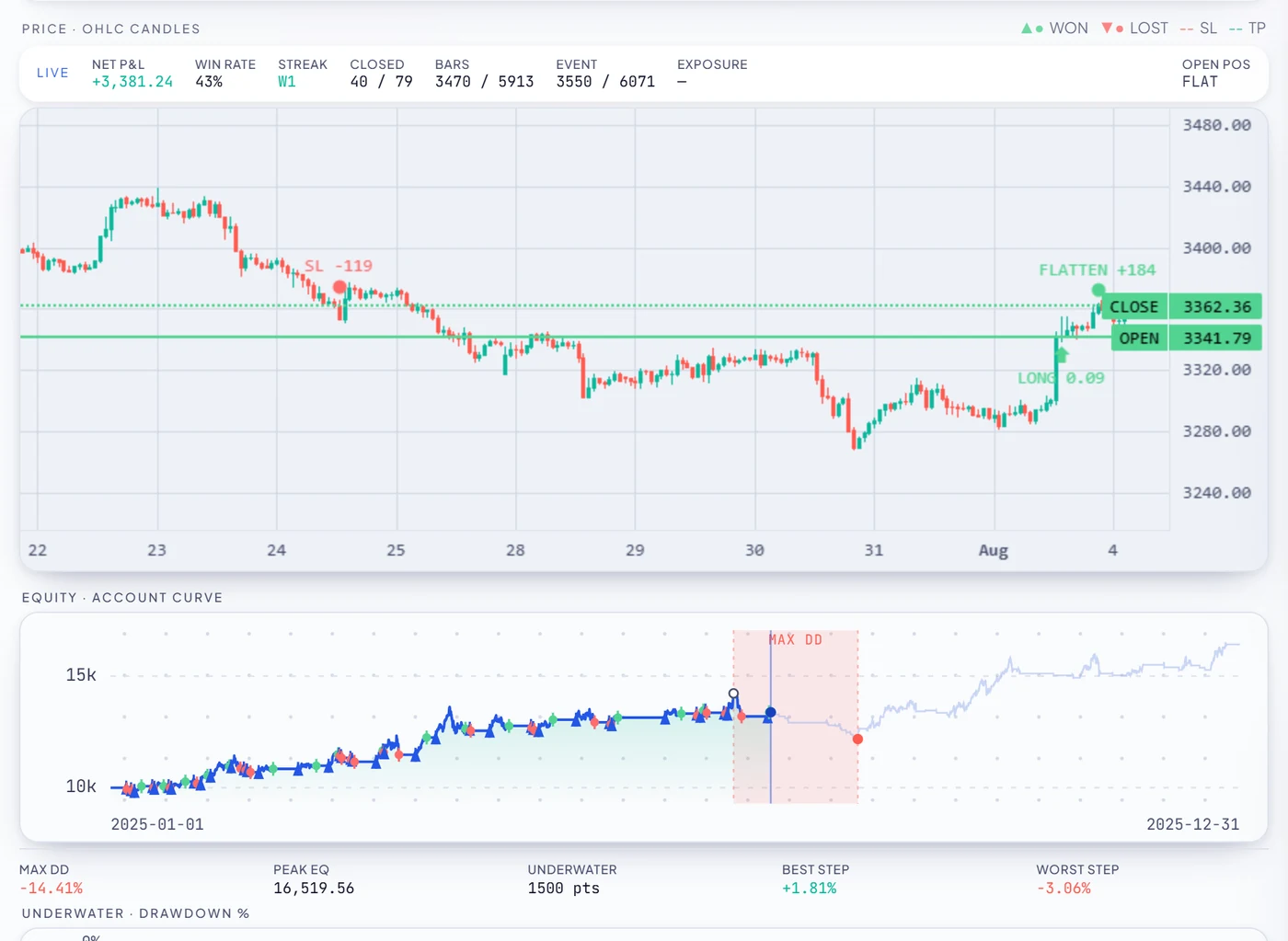
- Watch it trade. A replay of individual trades shows behaviour a summary hides: averaging down, stops that move, positions held through weekends.
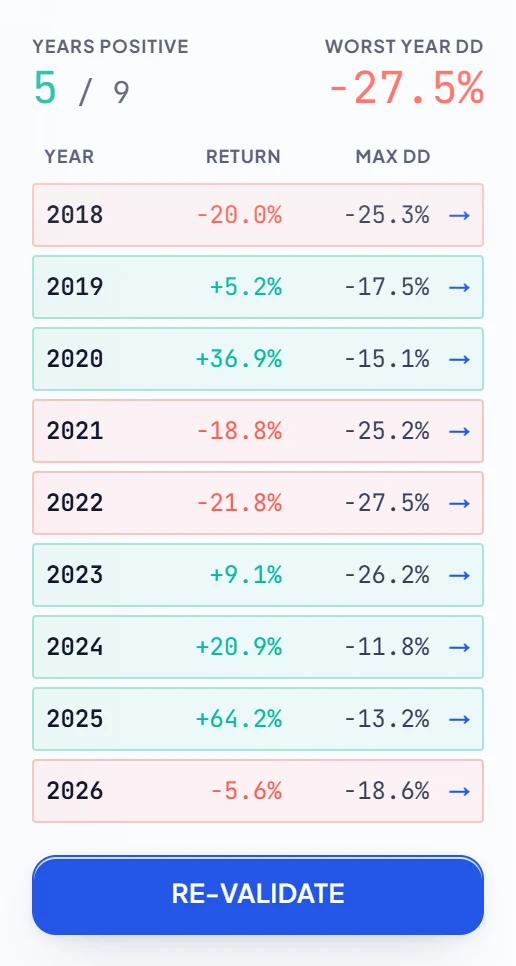
This is how RoboticEA answers those questions for its own strategies. Here is the top strategy from the batch above, validated: every year run as its own backtest, each with its return and maximum drawdown, and the red years left in place:
And any year can be opened and replayed bar by bar, with each entry and exit on the candles and the equity curve drawing underneath, including the worst drawdown window:
When a strategy passes, the export is a MetaTrader 5 expert advisor as .mq5 source with named, labelled inputs, so the last check — reading what you are about to run — is possible too. The free expert advisor guide walks through that file, and the parity study shows how our engine compares with MetaTrader 5’s own Strategy Tester.
Buying
Choosing an AI trading app: what to look for
If you are comparing trading bots or AI trading apps, the useful comparison is not whose model sounds cleverer. It is whose evidence you can check. A short list:
- It tells you what the AI does — in a sentence, not a slogan. If it claims to predict the market, ask for out-of-sample results on data the model never saw.
- It shows failures. A tool that only ever surfaces winners is showing you a selection, and selection is the effect measured above.
- It states its cost model and lets you see the spread charged per trade.
- It lets you leave. Readable output you can run on your own platform beats a black box tied to one service.
- It makes no profit promise. Any app that guarantees returns has told you the most important thing about itself.
RoboticEA is built against that list, and it has limits you should weigh: the AI tuner is a paid feature, a single batch tops out at 100 strategies, and most of what any search produces — ours included — does not survive validation. We think the right AI trading tool is one that makes the losing evidence easier to see, not harder.
Limits
What we have not shown
- Every figure here is a simulation. We hold no live trading record, and a strategy that passed every year in a backtest can lose money from the day it goes live.
- We did not test anyone else’s AI. The out-of-sample results measure selection by past return, the mechanism every history-fitted bot shares. They do not prove that no forecasting model works; that is a claim we have not earned.
- The holdouts are one study. 48,640 runs, 12 instruments, 3 timeframes, 4 time splits. Better selection methods may transfer better; we have not measured them at this scale.
- A better prompt is not a better strategy. We have not measured whether batches tuned by the AI validate better than batches tuned by hand, and we make no claim that they do.
FAQ
Questions, answered
What is an AI forex trading bot?
A forex trading bot is a set of rules a platform executes for you: when to enter, where to exit, how large a position to take. "AI" can mean three different things: a model that claims to forecast prices, a search tool that generates and tests many rule sets and keeps the best scorers, or a language model used as an interface. Once running, every bot is a fixed recipe reacting to prices, so the label matters far less than the evidence behind the recipe.
What does the AI do in RoboticEA?
It translates. On the Compose screen you describe the strategy you want in plain English, and a language model turns that sentence into the generator's settings: which of 34 strategy archetypes to draw from, lookback, reward to risk, stop distance, risk per trade, entry confirmations and exit styles. Code then clamps every value to fixed bounds (risk can never exceed 10% per trade) and drops anything not on the list. The AI never sees market data and never forecasts a price. A deterministic generator builds the strategies and our own engine backtests them.
Do AI forex trading bots work?
No label makes a bot work; out-of-sample evidence is what matters. In a 48,640-run study we took the top 25 strategies by in-sample return and ran them on 12 instruments: on H1 they made +15.25% on their home instrument and -18.27% on instruments they were not chosen on. A top-10 selection that returned +40.70% in sample averaged -26.26% on years it was not picked on. Any bot fitted to history, including one built with AI, faces that same gap.
Can an AI trading bot predict forex prices?
Nothing in RoboticEA tries to, and we have not seen evidence that convinces us otherwise. A model fitted to past prices will always describe that history well, which is exactly what makes its backtest uninformative. We did not test other vendors' models, so we do not claim no forecasting model works; we only show that selecting on past performance does not transfer reliably, and ask any bot claiming prediction for results on data it never saw.
Are AI forex trading bots a scam?
Usually not fraud in the strict sense, but often unverifiable. Hidden rules, one compounded curve, an unstated cost model and undisclosed selection add up to a record nobody can check. Costs alone are enough to manufacture a record: in our gold study, switching trading costs off made 65 strategies profitable in all 8 years, and charging the real recorded spread left 0. 24.0% of yearly runs were profitable only because costs were off.
Is the AI available on the free plan?
No. AI tuning is available on paid plans only. A free account gets a one-time grant of 250 tokens with no card and uses the manual sliders, which set exactly the same generator settings. Generating, backtesting, per-year validation, trade replay and MetaTrader 5 export are all available on free.
How can I test a forex trading bot myself?
Ask, cheapest first: can I read the rules? What spread and commission were charged, in numbers? Show me every year separately, losing years included. What was the maximum drawdown beside the return? How many trades a year? Was it tested on years or instruments it was not chosen on? Then watch it trade in a replay. A bot that cannot answer these has a screenshot, not a record.
Keep reading
Do forex robots actually work?
The full selection study behind the transplant figures above, plus the population every robot is drawn from.
Best gold expert advisor for MT5
The 186,637-run XAUUSD study the cost experiment here comes from.
A free expert advisor for MetaTrader 5
What a free account includes, and what is actually inside the exported .mq5 file.
Does our engine agree with MetaTrader 5?
Run for run against MT5's own Strategy Tester. If the simulator is wrong, none of the above counts.
How the workflow fits together
Compose, backtest, validate, replay, export — in order, and why validation comes before export.
Test a strategy yourself
Free account, no card. Generate, backtest per year with real recorded spread, and export to MetaTrader 5.